MACHAS
News - All the latest news straight from the artists themselves

Giulia Conoscenti animates Dimartino’s song Agua, ¿dónde vas?
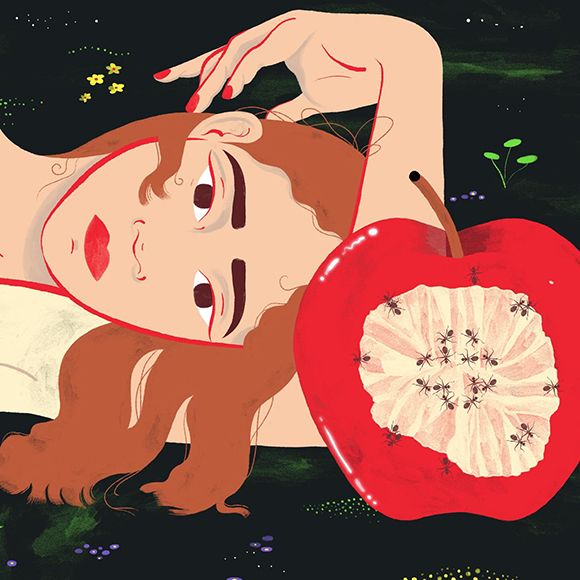
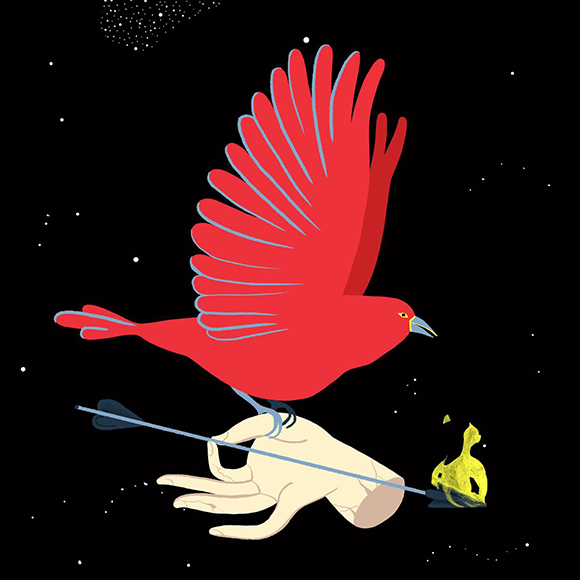
Dimartino, one of the most celebrated Italian singer-songwriters of his generation, chose Machas Artist Giulia Conoscenti to create the music video for Agua, ¿dónde vas?, a track from his new album L’improbabile piena dell’Oreto.
Drawing on a poem by Federico García Lorca, the song inspired Giulia to create a tactile, frame-by-frame meditation on the water cycle, where the river becomes a symbol of transformation and eternal return.
We sat down with Giulia and Dimartino to discuss the making of the project, the dialogue between music and animation, and the poetic world that shaped Agua, ¿dónde vas?.
Machas: Dimartino, what made you choose Giulia for this project?
Dimartino: I chose Giulia because I have always loved her illustrations. There is something psychedelic in the way she uses colour and shape, but at the same time, there is something deeply rooted in Palermo, the city we both come from. That connection is visible in her work, even when she is drawing dreamlike worlds. I felt that her visual language could naturally meet Lorca’s poetry and the atmosphere of the song.
Machas: Giulia, what drew you to the project when you first heard the track?
Giulia: Dimartino and I met years ago at a festival in Milan: he was singing, I was drawing, and I never stopped listening to his music after that. Agua, ¿dónde vas? is a very visual song; the first time I heard it, it opened up a whole world of images and colours for me.
Machas: Giulia, was there something in Dimartino’s music — the rhythm, the tone, or the emotional dimension — that guided your approach to the images? How did the sound shape your visual choices?
Giulia: Dimartino’s music shaped my entire visual imagination for the video: the colours, the settings, the figures. Dimartino has this remarkable ability to make you see his songs as much as hear them: you close your eyes and a whole world opens up. The rhythm of the song led me towards a story that does not really come to an end, that is never quite finished.
Machas: Dimartino, what was your reaction when you first saw Giulia’s interpretation of the song?
Dimartino: What surprised me most was how quickly she understood what the song was about. She immediately imagined water as a woman, which was very close to how I was thinking about it. For me, the river has always been a metaphor for human life, something that flows, changes direction and keeps moving. We understood each other immediately, and from that moment, everything developed very naturally.
Machas: Giulia, tell us a little more about your creative process. At what point did it surprise you? Was there a particular scene or sequence in the animation that felt especially meaningful or moving to create?
Giulia: The scene where the moon transforms into the sun, then falls into the woman’s arms and they dance together before turning into an hourglass: that is the one I loved most, both to make and to watch as a final animation. I find it deeply poetic and dreamlike, and I think it captures something true about the passage of time: the small, sometimes barely perceptible changes we go through every day, even when we do not notice them straight away.
Machas: Giulia, your work often seems to move between reality, dream, memory and symbol. How much of your own visual language made its way into this project, and how much was shaped directly by Dimartino’s song?
Giulia: That is a hard question to answer, because Dimartino’s song also moves between reality, dream and memory. I think what happened with this project was a perfect meeting — one where the line between my drawings and his music simply disappears. It is not clear at all where one ends and the other begins.
Machas: Dimartino, did the animation reveal any new meaning in the song for you?
Dimartino: Yes, definitely. The song already carried Lorca’s imagery, but Giulia brought new elements into it. She expanded the world of the song and made it feel more universal. The water became almost a mythical figure, a kind of nymph or spirit. Watching the animation, I sometimes felt I was discovering meanings that were not fully clear to me when I wrote and recorded the music.
Machas: Dimartino, is there a particular scene in the video that you love the most?
Dimartino: I really love the scene where she dances with the moon. Technically, I think it is one of the most beautiful moments in the animation. But what I love most is the idea behind it: the moon is no longer something distant; it becomes something you can hold, play with, and dance with. There is a sense of wonder in that scene that I find very moving.
Machas: Giulia, this is not your first musical collaboration. What fascinates you about bringing image and sound together? Do you see music videos as a space for storytelling, experimentation, or something closer to visual poetry? What matters to you when choosing a collaboration?
Giulia: I love it when illustration and animation meet music, because each one completes the other and something new is born — sometimes something a little unexpected. For me, animation is less predictable than a static image: you begin a story, but it does not always end up where you planned. It finds its own path and surprises you. When I start a collaboration like this, what matters most is that the music and the words make me travel a little, that they stir something in me, whether pleasant or not.
Machas: Dimartino, what did you enjoy most about collaborating with a visual artist on this project?
Dimartino: The thing I enjoyed most was seeing the song through someone else’s eyes. When you write music, you spend a lot of time alone with your own imagination. Collaborating with a visual artist allows you to let go of that control and be surprised. Giulia did not simply illustrate the song; she added her own dreams, symbols and ideas to it. It felt less like commissioning a video and more like having a conversation between two different artistic worlds.
See more of Giulia Conoscenti’s work here.